
Painting services
Consolidation
Cleaning
Lining
Strip lining
Dust lining
Fillings
Inpainting
Terminology
Paintings should be periodically inspected for condition problems. Use a strong hand-held light directed parallel to the picture plane. This “raking light” will illuminate surface variations. If any stages of deterioration are detected, try to eliminate the causes and consult a conservator. The layer of protective varnish on most paintings will enable a conservator to clean the surface safely, if it has yellowed or looks dirty. Do not attempt to clean the painting yourself. You can never be sure there is no loose paint!
The following terms are used by conservators and are useful during the examination of a painting. These terms assist an owner to understand the nature of a painting and to recognize the symptoms of deterioration:
abrasion: mechanical loss of layers of paint or ground. Something has rubbed or scraped the surface of the painting, exposing vulnerable layers to atmospheric conditions and to dust and grime.
accretion: deposit of foreign matter on the painting’s surface. Fly specks and splatters are examples of commonly found accretions.
blister: area protruding from the painting’s surface. A blister indicates separation (see cleavage) of the paint from the ground, or both layers from the canvas or panel.
bloom: cloudy area in all or part of the varnish film. Moisture or other pollutants may be causing the breaking down of the protective surface layer.
buckling: ripples in a canvas. The canvas may have slackened on its stretcher or the outer layers of paint and ground may be blistering because of shrinking of the canvas or other support.
canvas: cloth usually made from cotton or flax, used as a support for paint when stretched over a wooden frame.
chalking: powdering off of the pigment in a paint layer. This condition usually indicates either a lack of binding medium in the paint as originally applied or the existence of deteriorating conditions.
check: incomplete separation along the grain of a wooden panel (see split).
cleavage: separation of any of the paint or ground layers. Cleavage occurs when the cohesion of these layers has deteriorated from age, atmospheric conditions, or physical damage.
crackle: overall pattern of fine cracks, which may appear in any of a painting’s layers. Aging causes cracks which affect paint and ground layers; drying causes cracks when the films contract too rapidly or when the artist incorrectly applies the paint. A blow or any other form of external pressure causes what is known as mechanical cracking, often evident in a circular pattern.
cupping: areas of aged paint, loosened by surrounding cracks, whose edges curl up creating cup-like formations on the painting’s surface.
draw: system of radiating or parallel wrinkles from a corner or edge of a canvas. Uneven swelling or shrinking of canvas causes a draw.
flaking: extreme stage of cleavage and cracking in which paint and or ground layers partially or completely break away from the support.
gesso: white priming composed of inert pigments bound with glue size, which is used as a ground layer for oil and tempera paintings.
grime: any sort of soil or dirt which may lie on the surface of a painting or may be trapped beneath the films.
ground: opaque coating used to prepare canvas or panel for receiving paint. Glue and oil are commonly used as media for earth colors or white lead and driers.
inpainting: new paint applied to areas of loss on a painting. Good conservators are careful not to obscure original paint.
key: triangular piece of wood which fits into the inner corners of a stretcher to maintain tension on the canvas. The stretcher and key format allows the canvas to be tightened if it has become slack (see stretcher).
lining: new fabric attached to the back of a canvas painting to reinforce the original fabric.
medium: vehicle, such as water or oil, holding pigment particles in suspension in paint.
moisture barrier: substance often laid on the reverse of a relined canvas, or on the reverse and edges of a panel to guard against
changes in humidity.
overcleaning: the accidental removal of the original paint surface during cleaning.
overpainting: restorations which partially or completely obscure original paint.
paint: mixture of finely ground pigment in an appropriate medium which dries to an adherent film. Usually, the various types of paint, such as watercolor, tempera, and oil, are made with the same pigment substances. The binding media are different. Water-soluble gums and glues are used for watercolor; egg yolk and water sometimes mixed with oil, is used for tempera; drying oils are used for oil paint.
panel: wooden support for a painting. Masonite, canvas-covered paper board, or any other rigid support is also called a panel.
priming: a layer applied over the ground to create a colored tone for the painting. Often, the term is used to mean the same as ground.
size: water-soluble mixture of gelatin, skin glue, starch, resin, or gum used to prepare raw canvas. Size protects the fabric fibers from destructive elements in the ground.
split: complete separation along the grain of a wooden panel.
strainer: wooden frame, which provides the auxiliary support for canvas. the strainer mearly strains the canvas fabric over the frame. does not expand
stretcher: wooden frame, which provides the auxiliary support for canvas. The stretcher has tongued and slotted joints which are reinforced by keys.
stretcher crease : line inside the edge of a canvas painting showing the form of the stretcher underneath. The stretcher crease appears when the canvas has become slack and is usually accompanied by paint loss along the formation.
support: the material, such as canvas or wood, that provides the foundation for a painting.
varnish: solution of resins in oil or solvent, which when sprayed on the surface of a painting, forms a hard lustrous protective coating.
summation:
Following strict procedures for environmental control and safe handling will, in most cases, keep a painting in excellent condition. Occasionally, particularly with some twentieth-century works, the artist’s techniques will have been experimental, and the bond of the layers will give way no matter how much care the work of art receives. Only conservation can save a painting in this case.
It is very important to follow basic preservation procedures and to be able to recognize the beginnings of serious problems, but remember that any special concerns should he addressed to a reputable conservator. Museums and knowledgeable individuals may provide the names of professionals in the field of conservation. When selecting the conservation specialist best qualified to work on a painting, it is up to the owner to investigate thoroughly the training, experience, and philosophy of the conservator under consideration
A well cared for painting will exist for generations, not only giving aesthetic pleasure, but also offering valuable historical evidence of its time.
Photos
Abrasion / Overcleaning
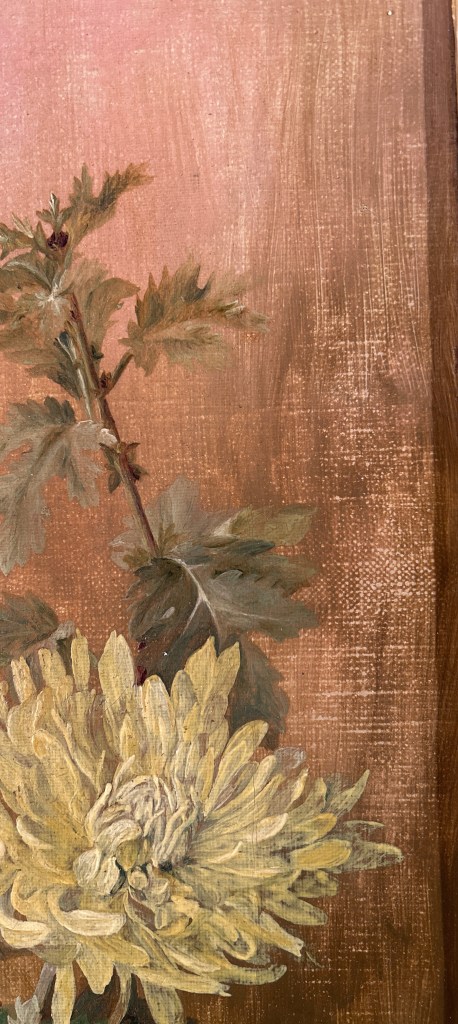
Mechanical loss of layers of paint or ground. Something has rubbed or scraped the surface of the painting, exposing vulnerable layers to atmospheric conditions and to dust and grime.
Bloom / Hazing

Cloudy area in all or part of the varnish film. Moisture or other pollutants may be causing the breaking down of the protective varnish layer
Blistering
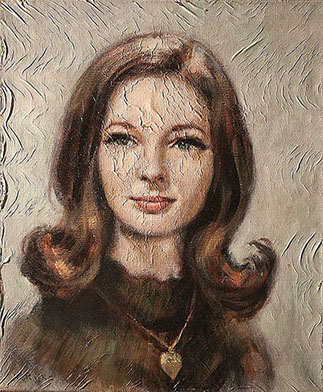
Area protruding from the painting’s surface. A blister indicates separation (see cleavage) of the paint from the ground, or both layers from the canvas or panel.
Inpainting
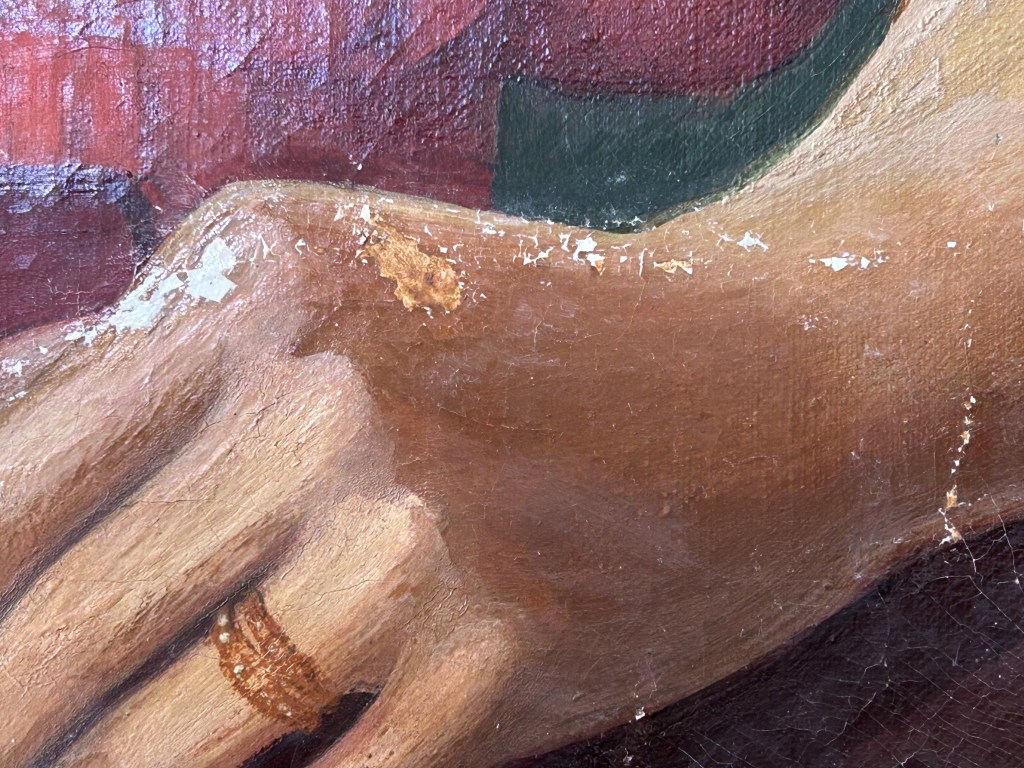
New paint applied to areas of loss on a painting. White areas are former losses that have been filled with a reversible vinyl fill. These areas willl be inpainted with reversible media to match the original composition. Good conservators are careful not to obscure original paint.
Stretchers vs strainers


Stretchers expand and give tension to the material put on it while a strainer only strains the material and does not expand. Photo on left is a stretcher with “keys” to enable expansion of the frame. Photo in center is a strainer where the corners are fixed, does not expand. Photo on the right is the back of a wood panel that has been mounted onto a “cradle” to prevent warping of wood panel.
Linings
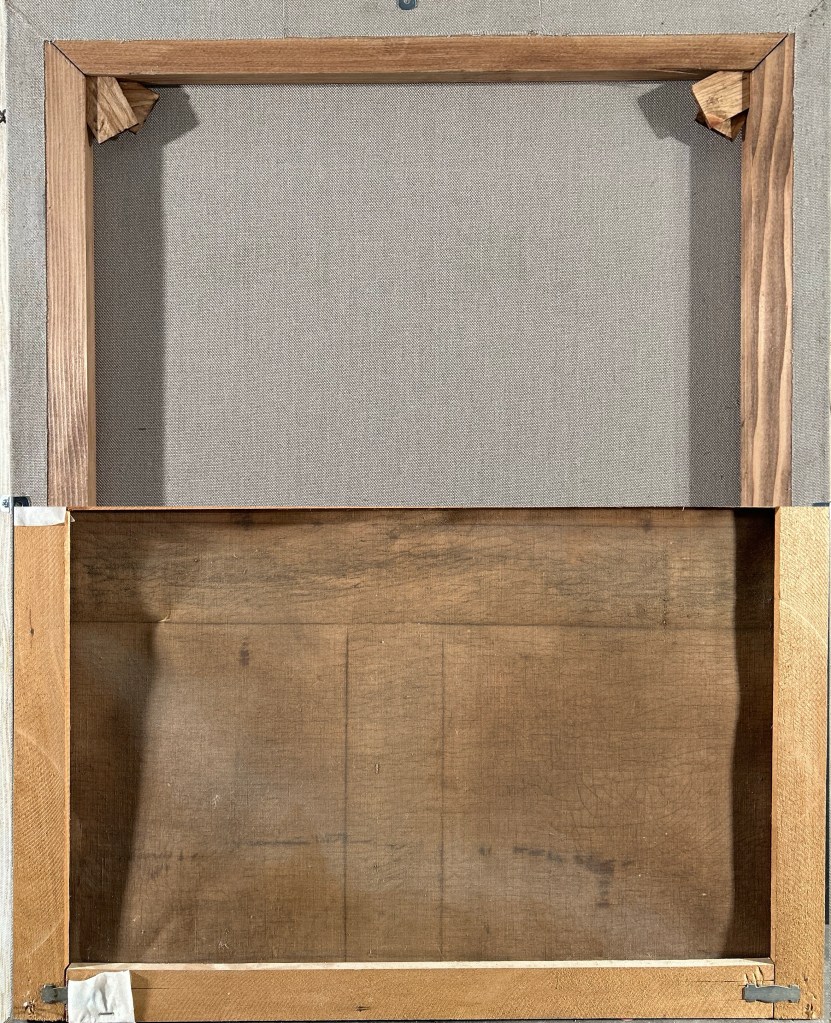
New fabric attached to the back of a canvas painting to reinforce the original fabric. Top half of painting has been lined the bottom part of the image is the painting as it came into studio unlined. To line a painting a polyester film interleaf is adhered onto a linen fabric with reversible thermally activated adhesive, BEVA 371. The painting is placed onto the laminate and is placed under vacuum hot table the painting is heated until the adhesive flows up and into the canvas to anchor the ground and paint film onto it original canvas support. The addition of the polyester film and linen add to the planar rigidity.
 Salah Art Conservation Studio